
Picture a small retail shop owner, up at 6 am, writing a product description for her new inventory by hand, answering the same five customer questions for the hundredth time via email, and trying to figure out why her Facebook ads aren’t converting.
Meanwhile, three blocks away, a competitor just launched the same product with AI-written copy, a chatbot handling all the FAQs, and a campaign that was A/B tested before it went live. The gap between them isn’t money, talent, or even effort. It’s a tool.
I’ve watched this play out over and over in conversations with business owners across industries. The ones who adopted AI early, even imperfectly, even messily, are operating with a leverage that’s hard to overstate. The others are still doing things the slow way, often without realizing just how slow it’s become.
This article is for the second group. Or for anyone who’s curious but not yet convinced. Because AI for small business isn’t a trend story anymore. It’s a survival story.
The Numbers Don’t Leave Room for Debate
Let’s start with what’s actually happening in the market, because the data is striking. We’re not talking about a slow, methodical shift. In fact, this has been a full acceleration.

58% | 55% | 91% | 96% |
Even so, that last number is particularly telling. Nearly every small business owner in the U.S. plans to adopt AI, which means the question of whether to use it has already been settled. The only thing still up for debate is timing, and for many businesses, the window to get ahead rather than just catch up is closing.
What the Data Actually Tells Us
Among companies with 10 to 100 employees, AI usage jumped year-over-year from 47% to 68%, a segment that represents the backbone of most local economies. And the J.P. Morgan Chase Institute found something remarkable about the pace of adoption: businesses starting in 2025 reached 10% AI adoption in just six months, compared to 77 months for the 2019 cohort, a 12-fold acceleration.
As a result, this isn’t a slow tide coming in. This is a wave that’s already broken.
Personal Observation
What strikes me about these numbers isn’t just their size. It’s how quickly they moved. In most technology adoption cycles, small businesses lag behind large enterprises by years. With broadband internet in the early 2000s, the gap was enormous. With AI, the SBA found that small businesses are now only about a year behind large firms in adoption rates. That’s genuinely unprecedented. And I think it says something important: the tools got simpler before small businesses had a chance to fall too far behind.
Where AI Actually Shows Up in Day-to-Day Business
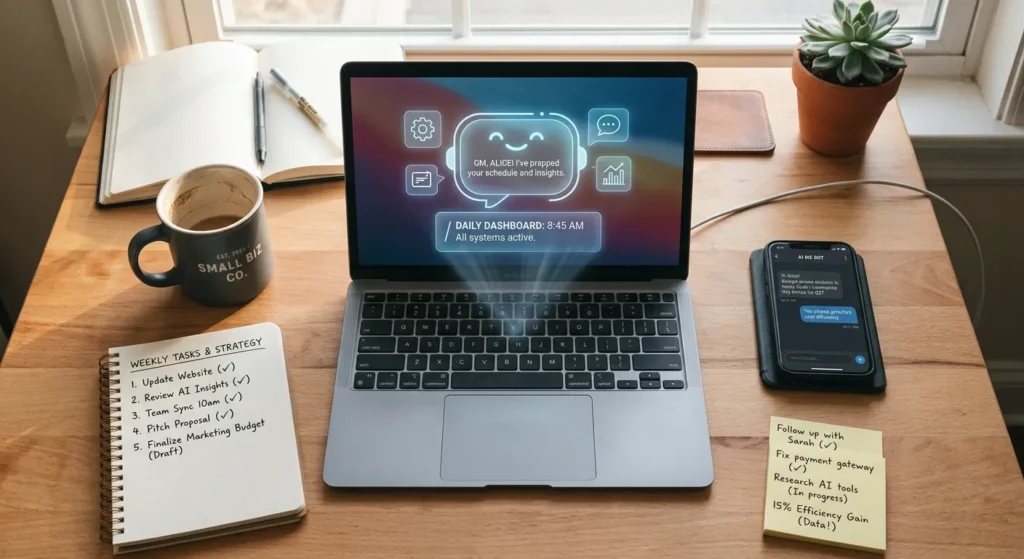
The biggest misconception I encounter is that AI is some abstract, futuristic concept that doesn’t apply to a landscaping company or a boutique law firm or a family-run restaurant. That’s just not true anymore. The practical use cases are everywhere, and most of them don’t require any technical background to implement.
✍️ Marketing & Content Writing product descriptions, blog posts, email campaigns, social captions. AI cuts this from hours to minutes, at a consistent quality most teams can’t maintain manually. | 💬 Customer Service Chatbots that answer FAQs at 2am, AI-drafted response templates, automated follow-ups. Customers get faster answers; you get your evenings back. |
📊 Research & Decisions Competitor analysis, pricing benchmarking, summarizing long documents, and turning raw data into readable summaries your team can actually act on. | 🗂️ Admin & Operations Drafting contracts, transcribing meeting notes, organizing emails, scheduling. All the repetitive paperwork that quietly eats 30% of most workdays. |
🧾 Finance & Reporting AI-powered bookkeeping tools, automated invoicing, expense categorization, and plain-language financial summaries without needing an accountant on call. | 🔍 Hiring & HR Writing job descriptions, shortlisting resumes, drafting onboarding documents, and building employee handbooks that actually sound human. |
The Entry Point Most Owners Miss
The Thryv survey noted that content marketing emerged as the most popular AI use case for small businesses, with two-thirds of SMB owners saying AI takes pressure off themselves and their staff. That tracks with what I’ve seen. The first win for most owners is usually getting help with writing, and once they see how good the output can be, they start applying it everywhere else.
“AI has been a game-changer for Henry’s House of Coffee, allowing us to streamline tasks like product descriptions, SEO, and marketing emails.”
Hrag Kalebjian, Henry’s House of Coffee, via U.S. Chamber of Commerce Report 2025
The Hidden Cost of Doing Nothing
Here’s the part most “AI for business” articles skip over: not adopting AI isn’t a neutral choice. It’s a decision with real costs attached to it. They just don’t show up on a balance sheet directly.

Think about time. A business owner who spends four hours a week on tasks that an AI tool could handle in forty-five minutes is losing 170+ hours a year. That’s more than four full work weeks. For a solo operator or a team of five, that’s not an inconvenience. It’s a structural disadvantage. And it compounds. While you’re drafting emails manually, your competitor is using that time to call new clients, refine their offer, or just breathe.
There’s also the quality gap that emerges quietly over time. When you’re stretched thin, marketing gets inconsistent. Response times slip. Product descriptions get rushed. Customer follow-up falls through the cracks. AI doesn’t eliminate these problems entirely, but it creates a floor: a baseline of quality and consistency that doesn’t depend on how tired you are on a Thursday afternoon.
The Competitive Gap You Can’t See on a Spreadsheet
And then there’s market positioning. Among SMBs using AI, 87% say it helps them scale operations and 86% see improved margins, according to Salesforce’s SMB Trends research. If those businesses are your competitors, they’re not just keeping pace. They’re building a structural advantage that grows over time.
Honest Perspective
I want to be careful here not to be alarmist. Fear-based marketing is a lazy tactic. But I do think there’s a real asymmetry that business owners need to understand. Early adoption of AI isn’t just about efficiency today. It’s about learning the tools, building the workflows, and training your team while the cost of experimentation is still low. In two years, the business that has been using AI daily will have a fluency that takes real time to develop. That’s not something you can fast-track later by simply downloading an app.
Answering the Objections Honestly
In practice, I hear the same hesitations from small business owners, and most of them are understandable. Here’s where I think the conventional wisdom is wrong, and where it’s actually right.
01 | Myth “It’s too expensive for a business my size.” Most of the best tools start at $0 to $30 per month. ChatGPT, Claude, Gemini, Canva AI, and Notion AI all have free or low-cost tiers that cover the basics. The ROI conversation starts almost immediately. |
02 | Myth “I don’t have the technical skills.” You don’t need any. The best AI tools today are built around plain language: you type what you need, you get an output. If you can write an email, you can use most AI tools effectively. |
03 | Partly fair “AI makes mistakes. I can’t trust it.” It does make mistakes. But so does every employee, every piece of software, every system. The answer isn’t avoidance. It’s review. AI handles the first 80% of a task faster than anyone; your job is to check and refine the last 20%. |
04 | Myth “My industry is too specific for AI to help.” This is the objection I hear most and believe least. The SBA Office of Advocacy found this belief is most common among the smallest businesses, specifically those with under 5 employees, and drops sharply as business size increases. In most cases, it’s an education gap, not an applicability gap. |
05 | Partly fair “I’m worried about privacy and data security.” This one deserves real attention. Don’t feed proprietary client data into public AI tools without reading the terms. Use enterprise tiers or privacy-first options when handling sensitive information. The concern is legitimate. The answer is informed use, not avoidance. |
The Revenue Case, in Plain Terms
Let’s talk about what this actually does to the bottom line, because the data here is unusually clear. Ninety-one percent of SMBs using AI say it boosts their revenue, with 78% calling it a game-changer for their company. Those are survey numbers, self-reported and worth some skepticism, but the mechanisms are real and traceable.
- AI-powered marketing converts better because it’s more consistent and easier to test at scale.
- AI-powered customer service retains clients because response time drops and quality holds up.
- AI-powered operations free up owner time, which gets reinvested into the parts of the business that actually grow revenue: relationships, strategy, sales.
The Salesforce research, drawn from 3,350 SMB leaders globally, put it directly: growing SMBs are far more likely to be investing in AI: 78% plan to increase AI investment, compared to just 55% of stagnant or declining businesses. It’s hard to tell whether AI is causing growth or whether growth-oriented businesses simply adopt tools more readily. Probably both. But the correlation is sharp enough that it’s worth taking seriously.
What I’ve Seen Work
The businesses I’ve seen get the most out of AI aren’t the ones who adopted every tool at once. They’re the ones who picked one broken process, usually something they genuinely dreaded, and used AI to fix it. The win built confidence. The confidence led to the next adoption. Within three to six months, AI thinking becomes natural. That’s where the real compounding starts.
Where to Start: A Practical First Step
The goal here isn’t to overwhelm you with options. It’s to get you moving. Here’s the simplest possible framework:
Step 1: Identify the one task you repeat most often that requires no deep expertise: writing similar emails, creating social posts, answering FAQs, summarizing reports. Just one.
Step 2: Spend thirty minutes this week using a free AI tool to handle it. Don’t aim for perfection. Aim for understanding.
Step 3: Evaluate the output. Edit what needs editing. Note what worked and what didn’t. Then do it again next week.
The point isn’t the task. The point is building the habit of thinking with AI, not just about it. Most people are surprised how quickly it clicks.
Five Tools Worth Starting With
General-purpose writing, research, brainstorming, customer email drafts. Free tier is genuinely capable. | |
Excellent for long documents, analysis, nuanced writing, and tasks that need careful reasoning. | |
Marketing graphics, social posts, presentations, with AI writing and design built in. No design background needed. | |
Meeting notes, project docs, SOPs, knowledge bases. Great for teams trying to get organized. | |
AI-powered customer chat for your website. Handles FAQs 24/7 so you don’t have to. |
The Bottom Line
AI is not going to replace what makes your business yours. It’s not going to replace your relationships with clients, your expertise, your judgment, or the reputation you’ve built over years. What it will do, and what it’s already doing for the majority of your competitors, is remove the ceiling on what one person or a small team can accomplish in a week.
The owners who got online early didn’t win just because they had a website. They won because they figured out how to use the internet before it became table stakes, and they built advantages that lasted. We’re at the same inflection point now, just moving faster.
The gap between small and large businesses in AI adoption has shrunk dramatically. small business usage reached 8.8% in production AI use while large business adoption held at 10.5%. For most technology cycles, small businesses were five to ten years behind. That gap is now less than a year. The playing field isn’t level yet, but it’s the closest it’s ever been.
The businesses that act this year will be the ones setting the pace in their markets next year. The ones that wait until AI is “obvious” will spend years closing a gap they didn’t have to fall into.
Pick one task. Spend thirty minutes. See what happens. The bar to starting has never been lower. The cost of not starting has never been higher.

Michael L. has spent the last one year writing about AI for people who never planned to care about it. He tests tools, cuts through the hype, and explains what actually works for everyday life and small business. No tech background required.