
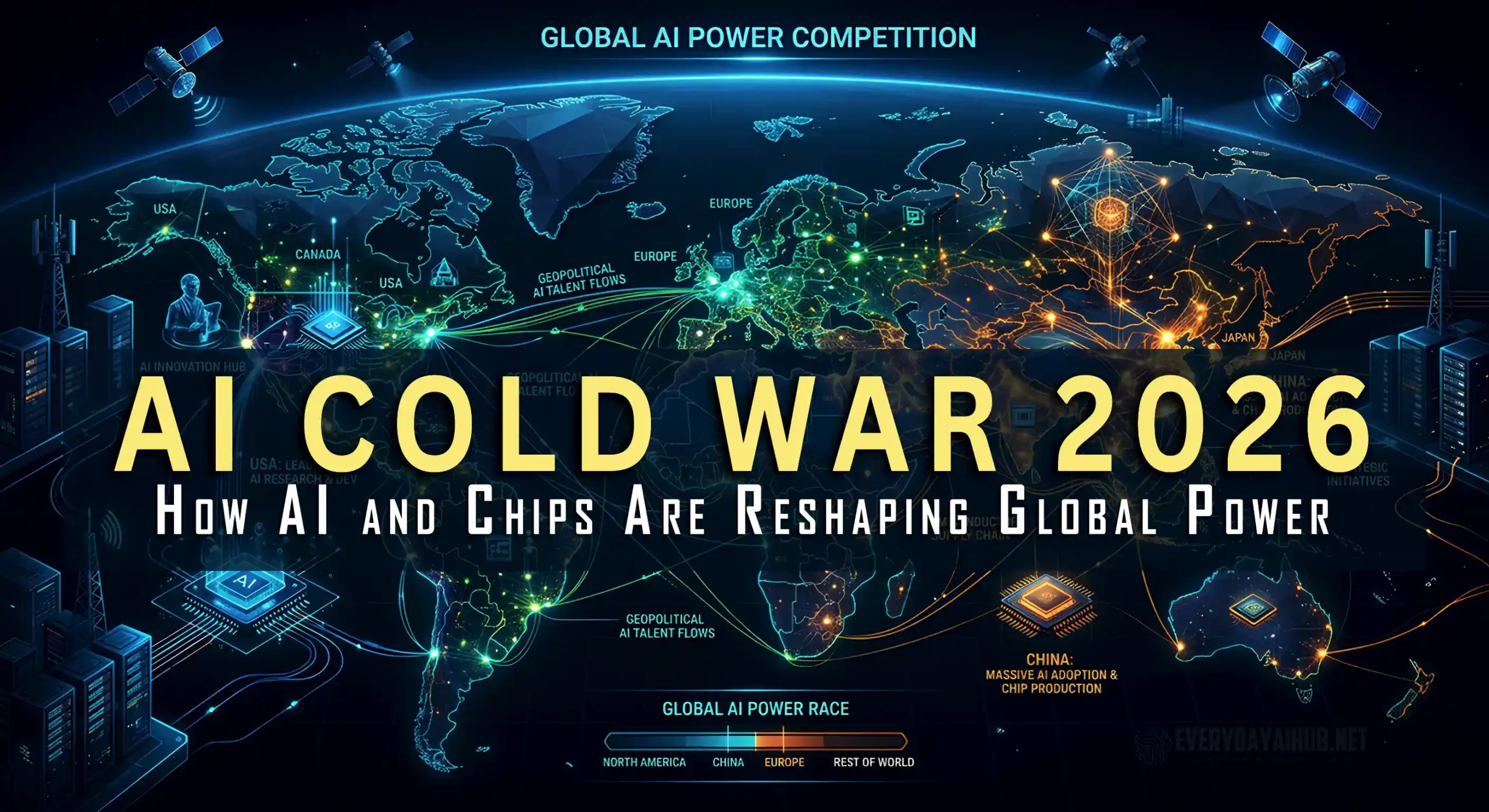
Introduction: A New Kind of Power Struggle
The AI Cold War in 2026 is no longer a future scenario. It is already underway, reshaping how global power is defined and exercised. Unlike traditional geopolitical rivalries built on military strength, this competition is centered on control over artificial intelligence, advanced semiconductors, and the infrastructure that powers them.
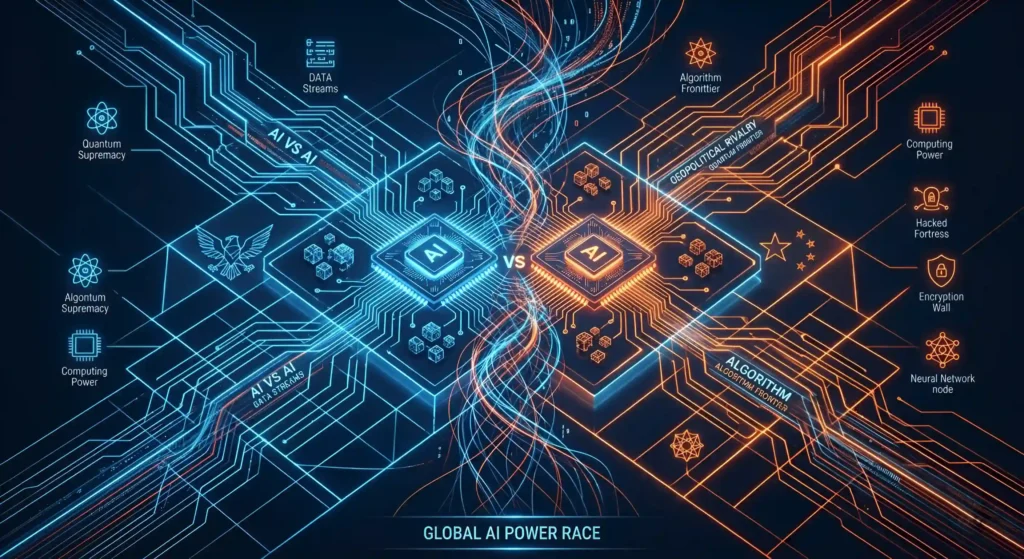
This shift is already visible in policy decisions. Since 2022, the United States has imposed export restrictions on advanced AI chips to limit access to high performance computing, particularly affecting companies in China. At the same time, analysis from the Center for Strategic and International Studies shows how AI competition is becoming a defining geopolitical factor.
More importantly, real-world incidents such as industrial-scale AI distillation attacks reported by Anthropic highlight how this competition is already playing out at a technical level.
What is emerging is not just a technology race, but a structural shift in how influence is built and maintained in the modern world.
What Is the AI Cold War in 2026?
The term “AI Cold War” describes a growing strategic competition between nations to dominate the development and deployment of artificial intelligence systems. According to the World Economic Forum, AI is rapidly becoming a central factor in global power.
However, Unlike the 20th-century Cold War, this conflict is not defined by direct confrontation. Instead, it plays out through:
- control over semiconductor supply chains
- access to large-scale data and compute
- dominance in AI research and deployment
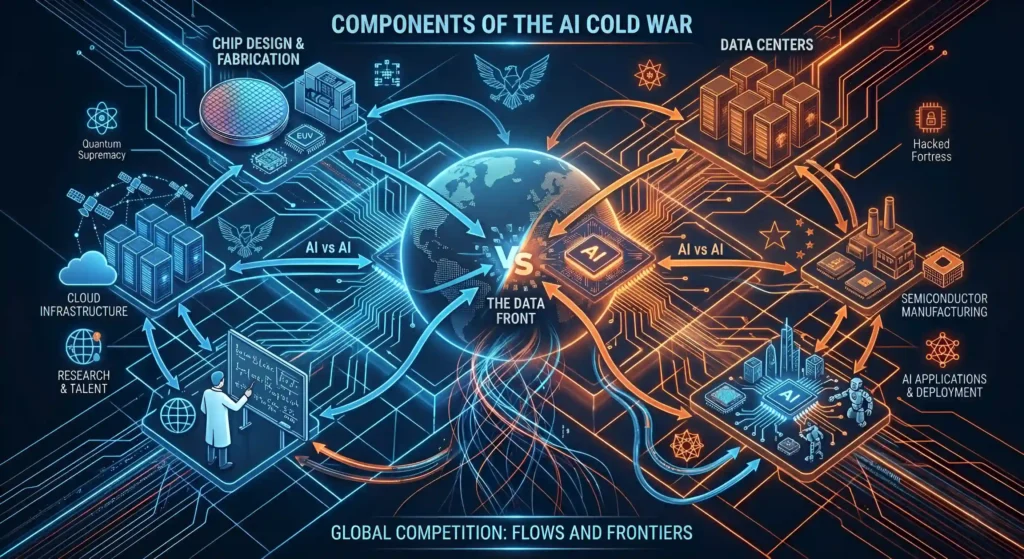
In practice, AI dominance depends on four key pillars: data, compute power, talent, and algorithms.
Therefore, the goal is not just technological leadership, but long-term control over digital infrastructure, which increasingly underpins economies, defense systems, and communication networks.
Why AI Is Driving the AI Cold War in 2026
AI is no longer just a tool for automation. It is becoming foundational infrastructure, similar to electricity or the internet.
This transformation is already visible in how AI is transforming industries like marketing and content creation, embedding itself into everyday systems.
This shift is reflected in national strategies. The European Union has introduced regulatory frameworks like the AI Act to govern AI development. At the same time, the AI Index Report from Stanford HAI highlights rapid growth in investment, model capabilities, and global adoption.
These moves indicate a clear shift:
AI is now viewed as critical infrastructure with geopolitical consequences, not just a field of innovation.
The Three Pillars of Power in the AI Cold War
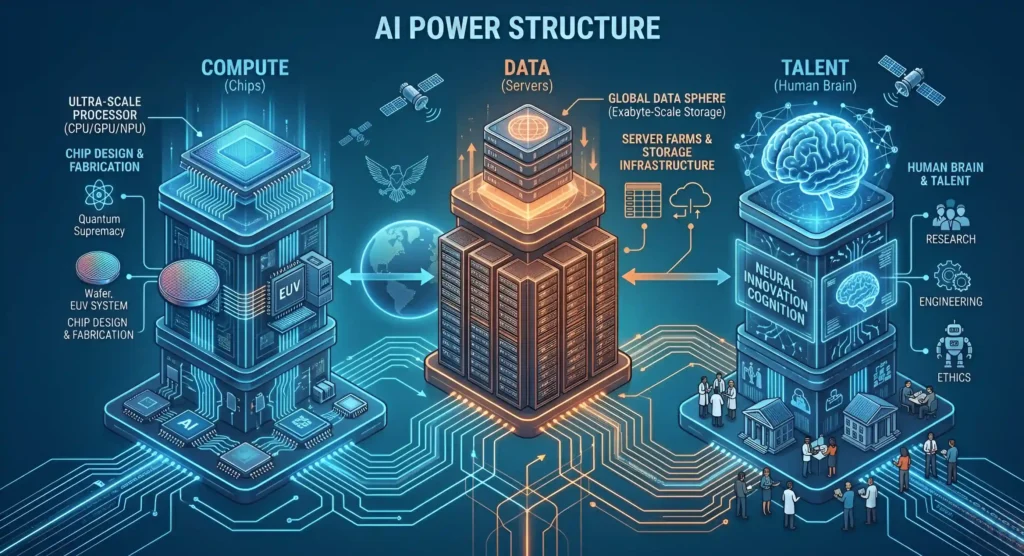
1. Compute Power and Chips
Advanced AI systems depend on high-performance chips. Companies like NVIDIA dominate this space through specialized GPUs used for large-scale model training.
Industry insights from the Semiconductor Industry Association show how strategically important and concentrated the global chip supply chain has become.
2. Data and Model Training
AI systems improve through exposure to large datasets. Access to high quality data is uneven across regions, creating structural advantages.
This is evident in how AI-driven data analytics tools are becoming a key competitive advantage across industries.
The OECD emphasizes in its AI policy analysis that data governance and accessibility play a major role in determining competitiveness.
3. Talent and Research
Top AI researchers are now strategic assets. Governments and companies are competing globally to attract and retain talent.
This trend is reinforced by how AI education and training systems are evolving rapidly, shaping the next generation of AI talent.
According to the global AI Index findings, talent concentration continues to influence which countries lead in innovation.
Export Controls and the AI Chip War
One of the clearest signs of the AI Cold War is the use of export controls as a strategic tool.
The United States has implemented advanced computing export restrictions to limit the flow of semiconductor technology to China.
Coverage from Reuters explains how these restrictions impact access to high-end GPUs used for training AI systems.
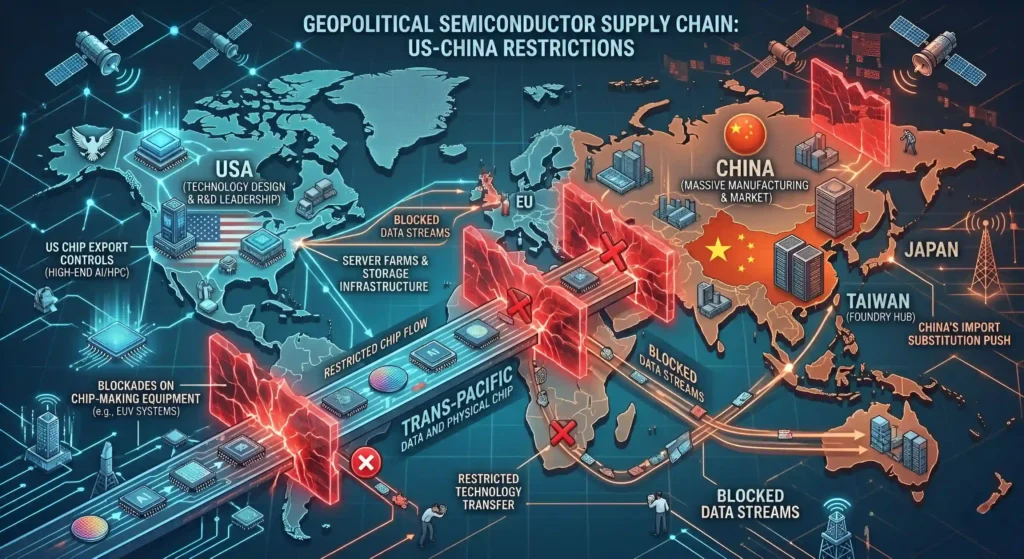
This is not just trade policy. It is a direct attempt to control the pace of AI development globally.
How Private Companies Are Shaping the AI Cold War
Unlike past geopolitical rivalries, private companies play a central role in this competition.
Organizations such as OpenAI, Google, and Microsoft are developing increasingly powerful AI systems while forming partnerships with governments and defense sectors.
This competitive pressure is already visible in cases like AI distillation controversies involving leading AI labs, where companies are accused of replicating advanced model capabilities.
Analysis from the Brookings Institution shows how public-private AI collaboration is reshaping global power.
This creates a new dynamic:
- innovation is driven by private firms
- strategic direction is influenced by national interests
The line between public and private power is becoming increasingly blurred.
The API Battlefield: Control Without Ownership
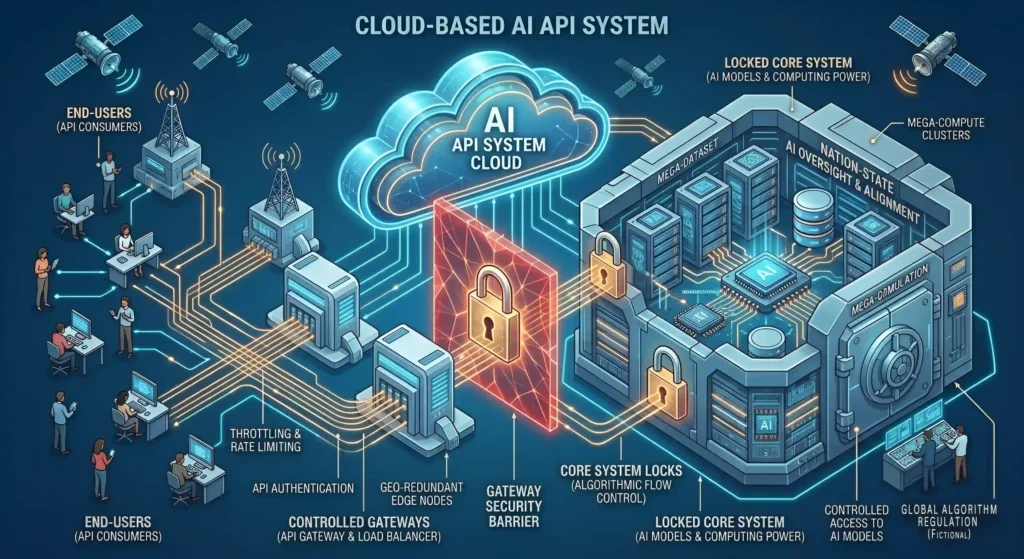
Another important shift is how AI systems are distributed.
Instead of releasing full models, companies now provide controlled access through APIs. Platforms operated by OpenAI and Google allow developers to use AI capabilities without direct access to the underlying systems.
This approach aligns with the AI Risk Management Framework by NIST, which emphasizes governed access and oversight.
Research from the OECD further highlights how centralized AI deployment improves accountability.
Global Ripple Effects of the AI Cold War
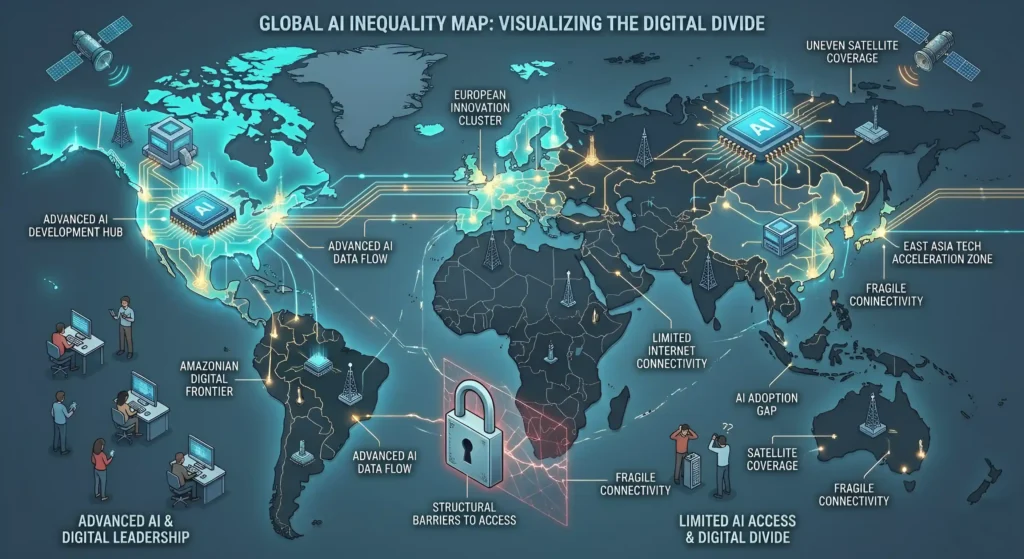
The impact of this competition extends far beyond leading economies.
Countries without access to advanced chips or infrastructure may become dependent on external providers, creating new forms of technological reliance. The World Bank highlights how digital inequality can increase due to unequal access to technology.
At the same time, regions like the European Union are working to build independent capabilities to reduce dependency on foreign systems.
FAQ
It refers to the global competition between nations to dominate artificial intelligence technologies and infrastructure.
AI influences economic growth, military capabilities, and information control, making it a critical strategic asset.
They restrict access to advanced hardware, which can slow down the development of large-scale AI systems.
They can replicate certain capabilities through distillation, but typically do not match full performance.
Conclusion: The Future is Being Defined Now
The AI Cold War is not a distant possibility. It is already influencing how countries make decisions, how companies compete, and how technology is controlled worldwide.
Control over AI increasingly means control over critical systems, from communication and finance to defense and innovation.
To understand how these technical conflicts are already unfolding, see our detailed coverage of AI distillation attacks.
Export controls, regulatory frameworks, and corporate alliances are actively shaping this new power structure. Research from the Brookings Institution suggests that AI will define future global leadership.
This is not just a competition over technology.
It is a contest over who controls access, who sets the rules, and who defines the future of digital infrastructure.