
The next competitive advantage for small businesses may not be hiring more staff. It may be building systems where AI handles work that previously required entire departments, at a fraction of the cost.
This is not a distant possibility. It is happening now. Small businesses that understand where AI is heading will be positioned to benefit from it. Those who treat AI as a static tool risk falling behind.
This guide covers the most important AI trends for small businesses in 2026, with practical examples you can act on today. But before diving into each trend, it’s important to see why understanding these shifts is critical right now.
Why AI Trends Matter More Than Ever for Small Businesses
For most of the past decade, enterprise technology arrived at large corporations first and trickled down to small businesses years later. That dynamic has changed.
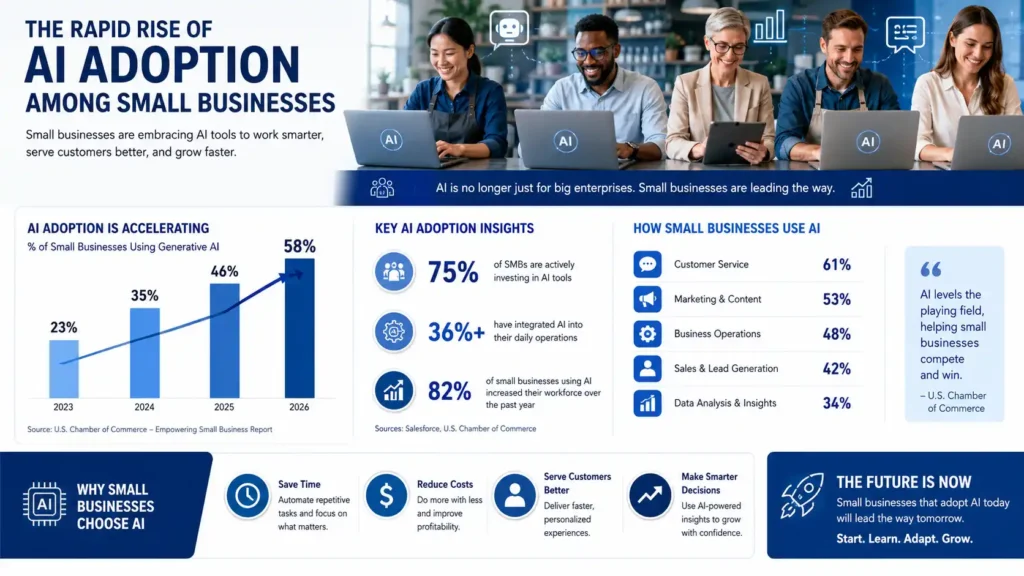
According to the U.S. Chamber of Commerce’s Empowering Small Business report, 58% of small businesses now use generative AI, up from just 23% in 2023. Salesforce research shows 75% of SMBs are actively investing in AI tools, and over one-third have already integrated AI into daily operations.
The gap between large corporations and small businesses in AI capability has nearly closed. In some cases, agile small businesses are now moving faster than slow-moving enterprises.
Understanding where AI is going is no longer a nice-to-have. It is essential knowledge for anyone running a business in 2026. The businesses that engage now will have a structural head start on those that wait.
Trend 1: Agentic AI: From Answering Questions to Taking Action
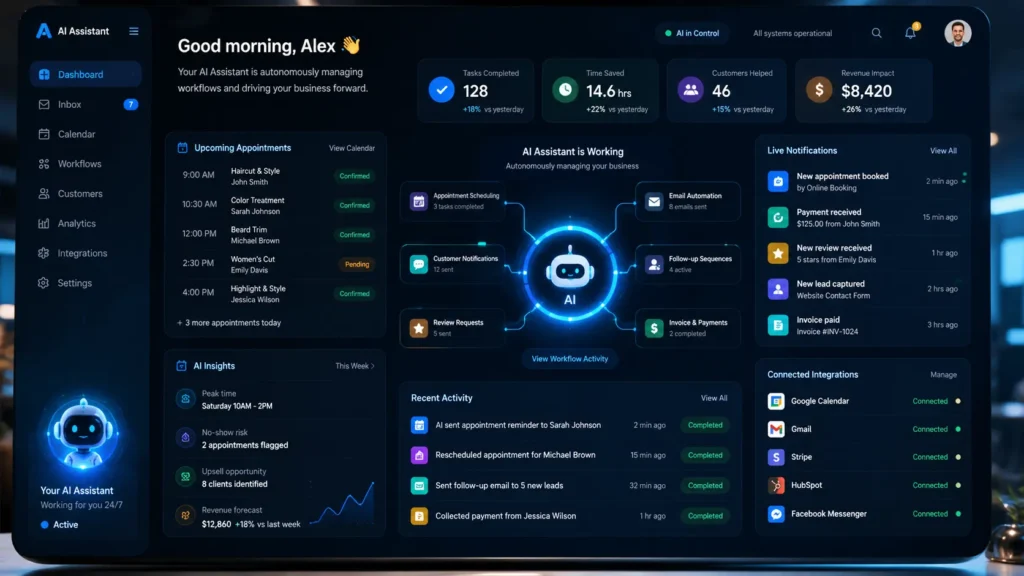
The most significant shift in AI right now is the move from tools that respond to systems that act. This is the core idea behind Agentic AI, and it is arguably the biggest AI trend for small businesses in 2026.
What Is an AI Agent?
A standard AI tool does something when you ask it to. An AI agent receives a goal, breaks it into steps, uses connected systems and tools, and completes multi-step tasks with minimal human input.
Real Small Business Examples of Agentic AI
Dental clinic: A standard Chatbot answers patient questions. An Agentic AI system monitors appointment no-shows, sends personalized rescheduling messages, updates the booking calendar, flags urgent cases for the front desk, and delivers a daily summary all automatically.
E-commerce store: An AI agent detects cart abandonment, determines the best recovery strategy for each customer, and executes it via email and SMS. A price-sensitive first-time shopper gets a discount. A loyal repeat buyer gets an early-access offer. No staff involvement required.
Where the Agentic AI Market Is Heading
As Oliver Parker, VP of Global GTM for Generative AI at Google Cloud, wrote in the Google Cloud AI Agent Trends 2026 report: “AI agents are the leap from being an ‘add-on’ approach to being an ‘AI-first’ process.”
Grand View Research estimates the AI agent market will grow at a CAGR of approximately 46% and exceed $50 billion by 2030. Separately, IDC projects that agentic AI spending will exceed 26% of worldwide IT spending by 2029, reaching $1.3 trillion a signal of how deeply this technology is expected to reshape how work gets done across every industry.
What this means for your business: Start with one low-risk, high-repetition workflow. Lead follow-up, appointment scheduling, or review management is a good starting point. Keep human approval in place for anything consequential. Tools like Make and Zapier now offer accessible agentic capabilities without requiring technical expertise.
Trend 2: Hyper-Personalization at Scale
Customers do not compare your business only to others like yours. They compare every interaction to the best experience they have ever had, regardless of who provided it.
The Old Problem and the New Solution
Delivering that level of personalization used to require large data science teams. In 2026, it does not.
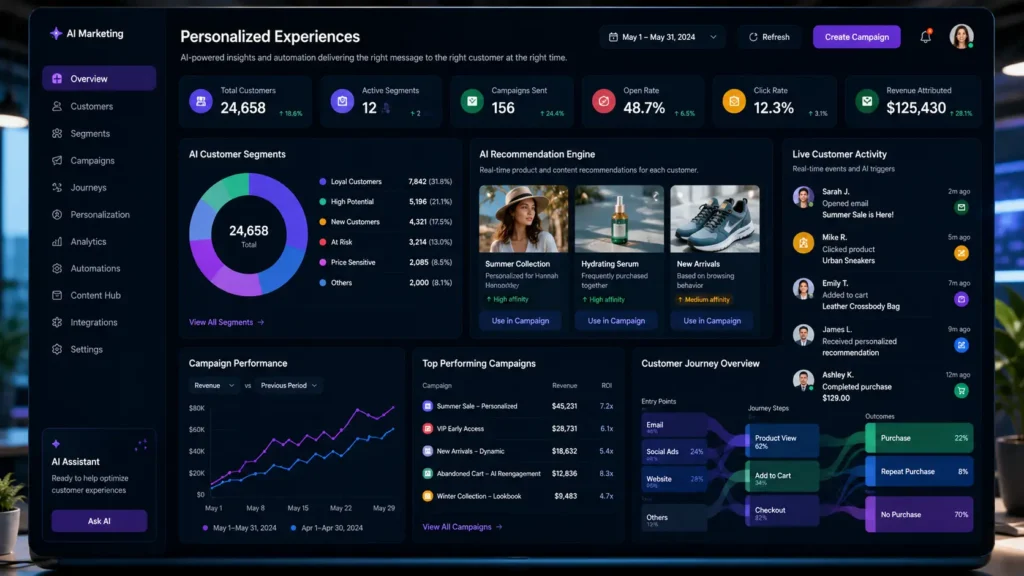
Consider two customers who both abandoned their shopping carts. A generic email treats them identically. An AI-powered system treats them as individuals. The first-time shopper gets a gentle reminder and a small discount. The repeat buyer gets an early-access invitation.
Timing, message, and channel are all automated based on behavior, not guesswork.
The Revenue Case for Personalization
According to McKinsey’s Next in Personalization report, companies that grow faster drive 40% more of their revenue from personalization than their slower-growing counterparts. Separately, 71% of consumers expect personalized interactions, and 76% get frustrated when businesses fail to deliver them.
What It Costs in 2026
Platforms like Klaviyo, Intercom, and HubSpot now bring these capabilities to small businesses for under $50 per month. Enterprise equivalents can cost $100,000 or more annually.
What this means for your business: Audit your current customer communication. If every subscriber gets the same message regardless of behavior, a basic AI-powered segmentation setup can meaningfully increase conversion and repeat business without adding headcount.
Trend 3: No-Code AI: Building Without a Developer
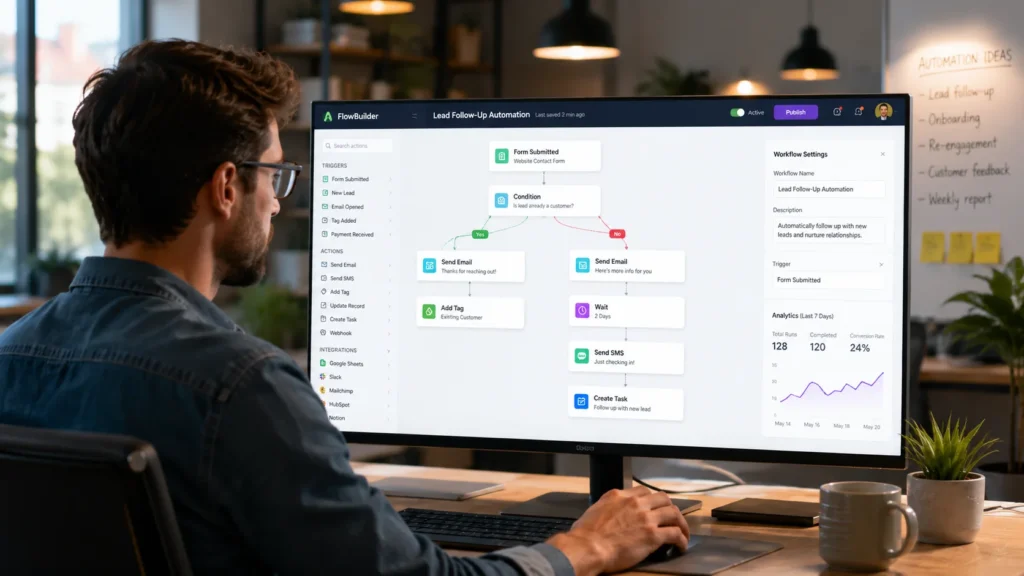
One of the most liberating shifts for small businesses is the rise of no-code and low-code AI platforms. These tools let business owners build sophisticated AI-powered workflows without writing a single line of code.
The Scale of the Shift
Gartner predicts that 70% of new applications will be built using no-code or low-code tools by 2025–2026. The market now exceeds $30 billion, with projections toward $65 billion by 2030. According to Gartner, citizen developers, non-technical staff building their own tools, are expected to account for at least 80% of low-code platform users by 2026.
Cost Comparison: No-Code vs Traditional Development
APPROACH | TYPICAL COST |
No-code AI platforms | $216-$300/year |
Traditional Custom Software | $70,000+ |
Practical No-Code AI Examples for SMBs
- A small law firm could build an AI-powered client intake process that collects information, summarizes key details, routes inquiries, and sends automated acknowledgements with no developer.
- A local gym could automate lead follow-up for trial membership inquiries, personalized to the class type each prospect showed interest in.
What this means for your business: Platforms like Make (formerly Integromat) and Zapier are within reach of any motivated owner. Start with one workflow that costs your team two or more hours per week.
Trend 4: AI-Powered Decision Intelligence
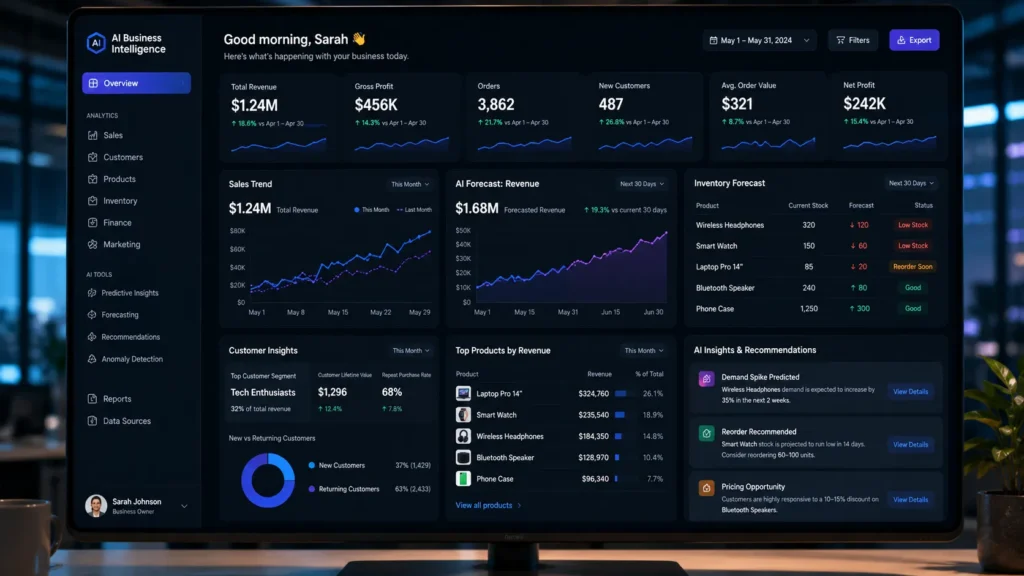
Running a small business means making high-stakes decisions with imperfect information. Which product line to expand? How much stock to order? When to hire?
Why Good Decisions Are Hard Without AI
These decisions have historically relied on instinct, spreadsheets, and experience. Over-ordering inventory ties up cash. Under-staffing damages customer experience. A loyal customer starts to drift, and no one notices until it is too late.
The signals are buried in data that takes too long to analyze manually.
AI Decision Tools Are Already in Your Software Stack
AI tools embedded in platforms you already use, including QuickBooks, Shopify, HubSpot, and Google Analytics, can surface these signals automatically and present them in plain language. No statistical expertise required.
The question is no longer whether small businesses can access decision intelligence. It is whether they know to look for it in the tools they are already paying for.
What this means for your business: Before buying a new AI tool, check what intelligence capabilities already exist in your current software stack. Most platforms have substantially updated their AI features in the past 12 months.
Trend 5: AI Search and Answer Engine Optimization(AEO)
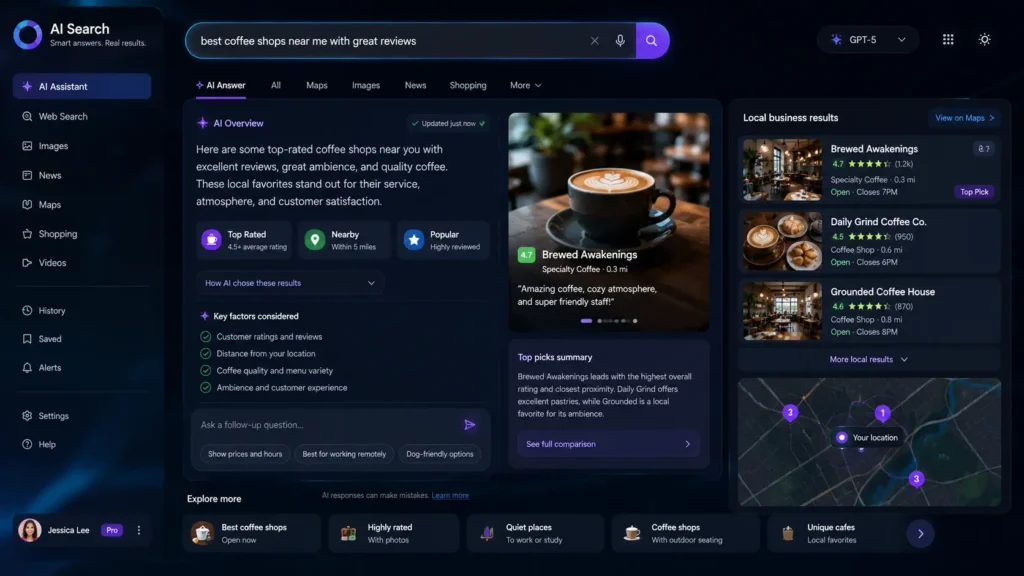
The way customers find small businesses online is changing fast. Many owners have not yet registered the significant this shift.
How AI Is Changing Search
Search engines are integrating generative AI into results pages and surfacing direct answers rather than lists of links. Google AI Overviews, Perplexity, and similar tools now answer many queries without users having to click through to any website.
Businesses may receive fewer total clicks but higher-intent traffic. If your business is not cited in AI-generated answers, it may not appear in the consideration set at all, regardless of where you rank in traditional search.
What Is Answer Engine Optimization?
Answer Engine Optimization (AEO) is an emerging discipline focused on creating content that is authoritative, clearly attributed, factually supported, and structured for AI systems to interpret and trust.
For local businesses, this means ensuring reviews, location data, and business information are prominent and consistent across Google Business Profile, Yelp, and Apple Maps, every platform where AI systems look.
As one retail technology researcher noted in a U.S. Chamber of Commerce feature: “If you’re not sharing your product information with the chatbots, you’re at a big disadvantage.”
What this means for your business: Ask yourself these three questions:
- Are you directly answering the questions your customers ask in clear, authoritative language?
- Are your reviews recent and actively managed?
- Is your business data consistent across Google, Yelp, and Apple Maps?
These factors are becoming central to AI-mediated discovery.
Trend 6: Responsible AI and the Trust Advantage

As AI becomes more capable, trust and transparency are moving to the center of the conversation. Small businesses are uniquely positioned to get this right.
The Real Fear Behind the Numbers
Research shows that 45% of small business owners worry that adopting too much AI could harm their company’s reputation. That concern is legitimate.
Small businesses often succeed because of their human qualities, the owner who remembers your name, the team that follows up without being asked. AI, deployed carelessly, can erode all of that.
The Framework That Works
The strongest approach keeps humans at the center of consequential decisions. AI handles the operational volume that would otherwise slow those humans down.
As LinkedIn’s Director of Research noted in a U.S. Chamber of Commerce feature: “To win in 2026, SMBs should upskill teams and leverage AI to make technology work for them, while they focus on earning trust and strengthening relationships.”
Customers who know you use AI to respond faster are not typically put off, especially when the outcome is a better experience.
What this means for your business: Be intentional and honest about your use of AI. Build internal policies around which interactions require a human response. Review AI-generated communications before they become your default voice. Trust is a competitive advantage worth protecting carefully.
Trend 7: AI Upskilling as a Strategic Priority
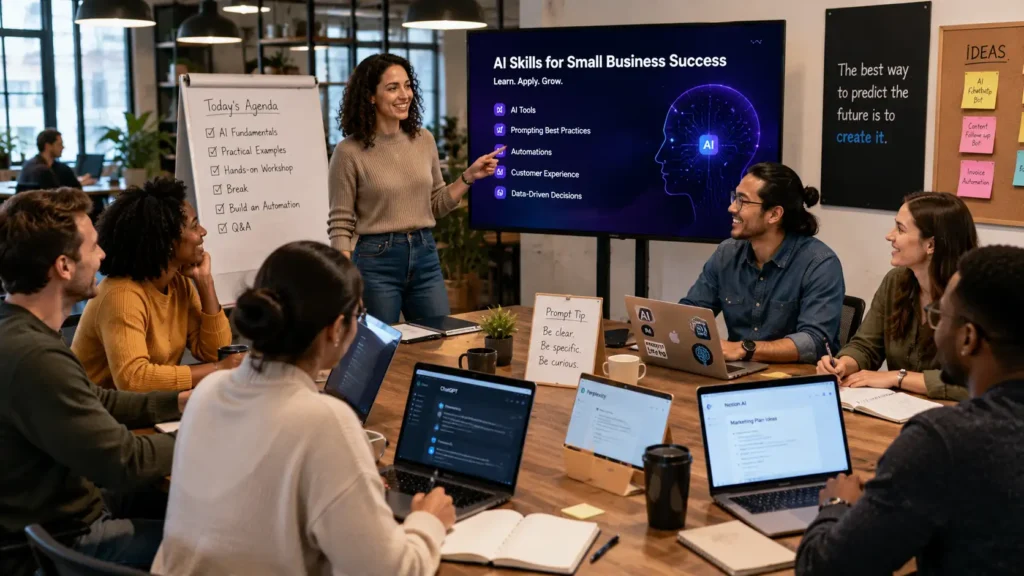
Every trend in this article depends on one thing: people who know how to use AI well.
It Is Not About the Tools
The businesses extracting the most value from AI in 2026 are not necessarily the ones with the most sophisticated tools. They are the ones whose teams understand how to direct AI effectively, evaluate its outputs critically, and integrate it into workflows with intention.
Coursera’s 2026 Job Skills Report, which draws on learning data from more than six million enterprise learners, identifies agentic AI and agentic workflows as among the fastest-growing skill areas in 2026. Enrollments in generative AI content grew 234% year-over-year. Separately, 64% of small businesses plan to launch AI training programs.
As LinkedIn’s research makes clear: “AI literacy is emerging as a driving force for small businesses.” It is the new competitive edge.
Small Businesses Have a Structural Advantage
Large organizations face bureaucratic approval layers that slow training rollouts. A small business owner can upskill a team of five in the time it takes a corporation to get a program approved.
Where to start:
- LinkedIn Learning — searchable AI courses across skill levels
- Google AI Essentials — free, practical AI training
- U.S. Chamber’s free AI training course — built specifically for small business owners
- Coursera — structured programs from university and industry partners
What this means for your business: Treat AI literacy as a skill set, not a one-time tool purchase. Identify one team member willing to become your internal AI champion. That person tests new capabilities, shares what they learn, and helps set standards for how AI is used across the business.
Three Predictions Worth Watching in 2026 and Beyond
1. AI Agents Will Become Standard Software Features
Within two to three years, most small business software will include AI agents by default. The tools you already pay for, your CRM, accounting software, and email platform will offer agent capabilities as standard features. Businesses that know how to configure and deploy those agents will capture significantly more value from software they already own.
2. AI Will Change How Customers Buy, Not Just How They Discover
OpenAI and Google have both launched agentic AI upgrades that allow their platforms to accept payments, place orders, and handle post-purchase interactions autonomously. For small businesses selling online, ensuring your product information is legible to AI systems will become as important as traditional SEO.
3. The Productivity Gap Will Widen
U.S. Chamber data show that 82% of small businesses that use AI increased their workforce over the past year. High-tech adopters consistently outpace low-tech competitors in sales and profit growth. As AI capabilities compound, this gap is likely to accelerate rather than narrow.
How to Prepare Your Business for These AI Trends
The trends in this article are not distant possibilities. They are already underway. A four-step framework for getting started:
Step 1: Audit Before You Invest
Understand how AI is already used in your business, both formally and informally. Identify your highest-friction workflows; these are typically the best candidates for AI support.
Step 2: Start Narrow, Prove Value, Then Expand
Focus on specific, measurable use cases. One well-implemented AI workflow that saves five hours per week per employee is worth more than ten half-used tools.
Step 3: Keep Humans at the Center
The most durable advantage for a small business is the quality of its human relationships. Evaluate every AI decision through that lens.
Step 4: Build for Learning, Not Just for Now
The AI landscape in 2026 will look different in 2027. Choose platforms that update regularly. Build general AI literacy rather than dependency on specific tools. Stay genuinely curious about what is emerging.
Frequently Asked Questions (FAQ)
The most impactful trends are agentic AI, hyper-personalization, no-code AI tools, and AI-powered decision intelligence. AI search and Answer Engine Optimization are also increasingly important for businesses that rely on online discovery.
No. This is one of the biggest misconceptions in 2026. Many capable AI tools have free tiers or start under $50 per month. No-code platforms typically cost $216–$300 annually, compared to $70,000 or more for traditional custom software. The more relevant question is whether you can afford the time you are currently spending without AI.
Agentic AI systems receive a goal, plan a sequence of actions, and complete complex tasks with minimal human input. Yes, it absolutely applies to small businesses. Examples include appointment-scheduling agents for clinics, lead-follow-up agents for service businesses, and cart-abandonment recovery agents for e-commerce stores. These tools are available on accessible, no-code platforms like Make and Zapier.
The evidence strongly suggests no. The U.S. Chamber of Commerce found that 82% of small businesses using AI actually increased their workforce over the past year. AI is most effective when it handles high-volume, repetitive tasks, freeing human team members to focus on judgment, creativity, and relationships.
Start with three steps. First, identify the two or three workflows that consume the most time with the least value. Second, check whether the software you already use has AI features you have not yet activated. Third, spend one hour per week as a team exploring a new AI tool or capability. Consistent, small-scale experimentation builds the literacy that leads to meaningful advantage.
AEO is the practice of optimizing your content so AI-powered search tools like Google AI Overviews and Perplexity cite your business in their answers. It involves creating authoritative, clearly structured content, maintaining consistent business information across platforms, and actively managing your reviews.
Conclusion
The businesses that thrive in the next five years may not be the largest or the oldest. They may simply be the ones who learned fastest.
The AI tools available to small businesses today would have seemed extraordinary just a few years ago. The tools available in two to three years will seem equally remarkable by today’s standards.
Agentic AI, hyper-personalization, no-code development, decision intelligence, and AI-mediated search are forces already reshaping the competitive landscape. The businesses that engage with them intentionally, with clear goals and genuine human oversight, will not just keep pace with larger competitors. In many cases, they will move ahead of them.
The technology has never been more accessible. The competitive window has never been more open.

Michael L. has spent the last one year writing about AI for people who never planned to care about it. He tests tools, cuts through the hype, and explains what actually works for everyday life and small business. No tech background required.