Small businesses initially embraced cloud AI because it was remarkably simple. For instance, operations followed a straightforward loop: upload data, get insights, and pay as you go. Initially, that approach worked well for a while. However, as AI models move from passive dashboards to real-time operations, many small businesses are running into significant operational friction:
- Checkout systems lag during peak hours
- Video analytics consume massive bandwidth
- Cloud bills rise faster than revenue
- Compliance risks grow as data leaves the premises
Crucially, the shift happening now is not about replacing the cloud entirely. Instead, it is about moving intelligence closer to where business actually happens. Consequently, this technological pivot is known as edge AI.
This guide explains what edge AI is, why it matters in 2026, how it compares to cloud-only AI, and ultimately, how small businesses can adopt it without overbuilding infrastructure.
What Is Edge AI?
Edge AI refers to artificial intelligence models that run locally on devices or on-site systems instead of relying entirely on remote cloud servers.
In practical terms, the workflow shifts as follows:
- A local device generates data (such as a camera, POS system, machine sensor, or medical scanner).
- An AI model running locally on-site processes that data.
- As a result, a decision is made instantly.
- Ultimately, only necessary summaries or results are sent to the cloud.
In contrast, this differs from cloud-only AI, where raw data must travel to a remote data center before analysis.
| Feature | Cloud AI | Edge AI |
|---|---|---|
| Data Processing | Remote data centers | On-site / local devices |
| Latency | Dependent on internet | Near real-time |
| Bandwidth Usage | High for video/sensor data | Significantly reduced |
| Internet Dependency | Required | Can operate offline |
| Compliance Exposure | Data leaves premises | Data stays local |
Furthermore, most modern deployments now utilize a hybrid cloud-edge architecture, where the edge handles real-time decisions while the cloud manages heavy model training and long-term analytics.

Why Cloud-Only AI Is Becoming a Limitation for Small Businesses
Undeniably, Cloud AI is powerful. However, but for operational environments, it introduces trade-offs that small businesses feel quickly.
1. Latency Affects Revenue
Even a minor 100–200 millisecond delay can negatively impact:
- Retail checkout experiences
- Security camera response times
- Automated quality inspection lines
- Fraud detection at point of sale
Therefore, in real-time environments, delay is no longer a technical issue; rather, it is direct operational bottleneck.
2. Usage-Based Pricing Scales Unpredictably
Cloud AI pricing often bundles multiple variables:
- Compute time
- Storage Capacity
- Data transfer Volumes
- API usage fees
Consequently, as data volumes grows, backend costs skyrocket. For example, video analytics and industrial sensors generate continuous streams, and bandwidth charges accumulate quickly. Many small businesses underestimate long-term inference and transfer costs.
3. Data Privacy and Compliance Pressure Is Increasing
Regulations such as:
- General Data Protection Regulation (GDPR)
- Health Insurance Portability and Accountability Act (HIPAA)
require strict handling of sensitive data. Transmitting raw video, customer behavior data, or medical scans to third-party cloud servers increases the complexity of compliance. For this reason, small businesses without dedicated legal teams find that this security risk heavily impacts their bottom line.
4. Internet Dependency Creates Operational Risk
If the local internet connection fails:
- AI systems stall
- Automation pauses
- Real-time monitoring stops
On the other hand, Edge AI allows core systems to continue operating even during connectivity disruptions.
What Changed Between 2022 and 2026?

Edge AI is not structurally new. However, what is completely new is its unprecedented accessibility for smaller enterprises.
1. AI Hardware Is Now Affordable for SMBs
Microchips like NVIDIA Jetson, Intel AI accelerator, and Google Coral have drastically reduced the financial barrier to entry.
In addition, AI acceleration is now built into many mainstream CPUs and business laptops. Small businesses no longer need enterprise-scale infrastructure to run local inference.
2. On-Device AI Is Expanding Beyond Vision
Edge AI used to focus on video analytics and industrial sensors. Now it includes:
- Local document processing
- On-device assistants
- Fraud detection models
- Generative AI summarization
ultimately, this expands use cases beyond manufacturing and retail.
3. Hybrid Architecture Is Becoming Standard
Instead of cloud vs edge, the winning model is:
- Edge for inference and real-time decisions
- Cloud for training, aggregation, and reporting
This balances cost control with scalability.
Core Benefits of Edge AI for Small Businesses
1. Real-Time Decision Making
When AI runs locally:
- Fraud detection happens instantly
- Inventory gaps are detected immediately
- Equipment anomalies are flagged before failure
For operational businesses, milliseconds matter.
2. Lower Long-Term Operational Costs
Edge requires initial hardware investment. But it reduces:
- Ongoing bandwidth usage
- Continuous cloud compute charges
- Data transfer fees
For high-data environments, total cost of ownership can become more predictable compared to cloud-only AI.
3. Improved Data Security and Sovereignty
Sensitive raw data remains on-site. Only processed insights leave the premises. This reduces exposure and simplifies compliance audits.
4. Operational Resilience
Edge AI continues functioning during internet outages. For manufacturing, healthcare, or logistics operations, this resilience is critical.
5. Better Customer Experience
Customers notice faster checkouts, fewer stockouts, less downtime, and smoother service. They may not see the AI. But they feel the efficiency.
Real-World Edge AI Use Cases for Small Businesses
Retail: Real-Time Inventory Monitoring
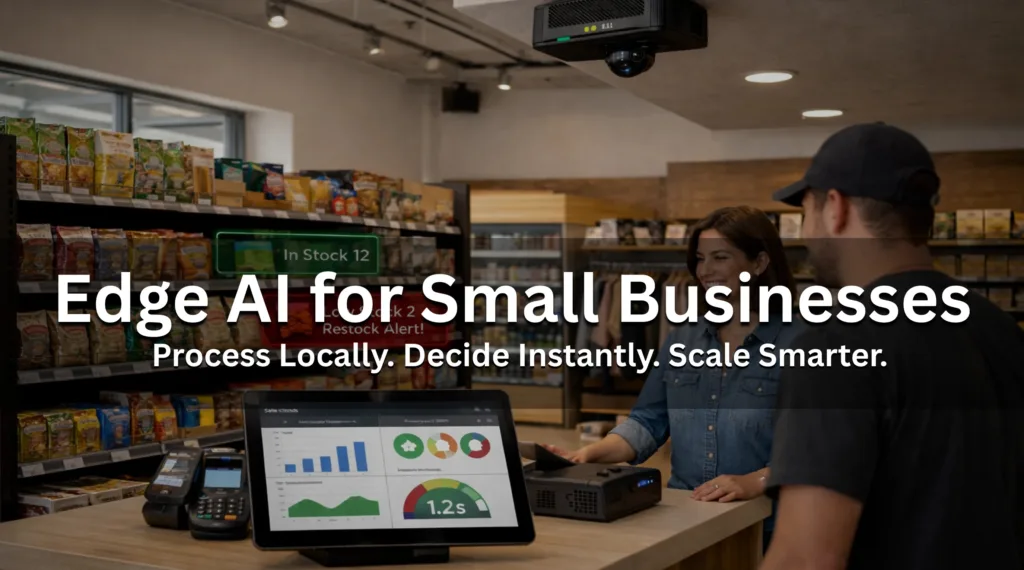
Instead of streaming camera feeds to the cloud, in-store edge devices analyze shelves locally. Benefits include faster stock detection, reduced bandwidth costs, and immediate restocking alerts. Some retail deployments report measurable reductions in stockouts after implementing local AI monitoring.
Manufacturing: Predictive Maintenance
Industrial sensors generate vibration and temperature data continuously. Edge AI can analyze this locally and detect anomalies before failure. Industry research shows AI-based predictive maintenance can reduce downtime significantly, often by double-digit percentages depending on deployment scale.
Healthcare Clinics: Local Imaging Analysis
Uploading high-resolution medical scans to the cloud creates delay, bandwidth strain, and compliance exposure. Processing imaging locally allows faster diagnostic support while transmitting only anonymized results for centralized reporting.
Logistics and Fleet Operations
Edge AI installed in vehicles enables driver behavior monitoring, route anomaly detection, and fuel optimization analysis. Decisions occur in real time without relying on constant connectivity.
Cloud vs Edge: When Should Small Businesses Choose Each?
Opt for Cloud AI When:
- Workloads are not latency-sensitive
- Data volumes are moderate
- Centralized analytics matter more than real-time automation
- You want minimal upfront investment
Select Edge AI When:
- Real-time decisions affect revenue
- You process continuous video or sensor data
- Internet reliability is inconsistent
- Data privacy is a major concern
Choose Hybrid When:
Most small businesses benefit from hybrid. Use edge for immediate decisions, data filtering, and automation. Use cloud for model updates, cross-location analytics, and long-term storage.
Step-by-Step Implementation Roadmap
Step 1: Identify Latency-Sensitive Processes
Ask: Where does delay directly impact revenue? Where does downtime hurt operations? Start there.
Step 2: Evaluate Data Volume and Sensitivity
If you process video feeds, payment data, medical records, or industrial telemetry, edge processing may reduce cost and compliance exposure.
Step 3: Start with a Pilot
Deploy edge AI in one location or workflow. Measure bandwidth reduction, downtime reduction, speed improvements, and operational savings.
Step 4: Maintain Cloud Integration
Do not remove the cloud entirely. Use it strategically for central reporting, model retraining, and multi-site coordination.
Step 5: Plan for Device Management
Ensure secure boot mechanisms, regular firmware updates, and remote model deployment capability. Ultimately, strict operational discipline matters.
Common Challenges and How to Address Them
Limited Technical Expertise
Solution: Use managed edge platforms, partner with system integrator, and choose pre-configured hardware.
Model Updates
Models can be trained centrally and pushed to devices periodically. Hybrid architecture simplifies this process.
Security Risks
Edge devices must be patched and monitored like any other endpoint. Therefore, implement encrypted storage, device authentication, and access control policies.
Frequently Asked Questions
Initial hardware costs exist; however, ongoing cloud and bandwidth savings can offset them in high-data environments. ROI depends on workload volume and latency sensitivity.
Yes. Edge systems can operate locally. In general, internet is typically needed only for updates and reporting.
Not universally. Rather, it is particularly well-suited to real-time, data-heavy, privacy-sensitive workloads. Many businesses benefit from hybrid models.
Retail, manufacturing, healthcare, logistics, and security-focused businesses see strong benefits due to real-time operational needs.
The Strategic Outlook for 2026–2030
Several trends are clear:
- AI hardware acceleration is now a default standard in business-class hardware.
- Privacy regulations are rapidly globally.
- Hybrid cloud-edge infrastructure has become the default architecture for serious enterprises.
- AI decision-making is moving closer to devices.
Small businesses that adopt edge AI strategically gain immense cost predictability, faster operations, reduced compliance complexity, and greater long-term operational resilience.
Final Takeaway
Edge AI is not about abandoning the cloud. It is about aligning AI infrastructure with real-world business operations. Therefore, If your business depends on speed, privacy, and reliability, cloud-only AI may not be enough anymore. Process locally, act instantly and send only what matters. For many small businesses in 2026, edge AI is no longer experimental. It is becoming practical infrastructure.

Michael L. has spent the last one year writing about AI for people who never planned to care about it. He tests tools, cuts through the hype, and explains what actually works for everyday life and small business. No tech background required.