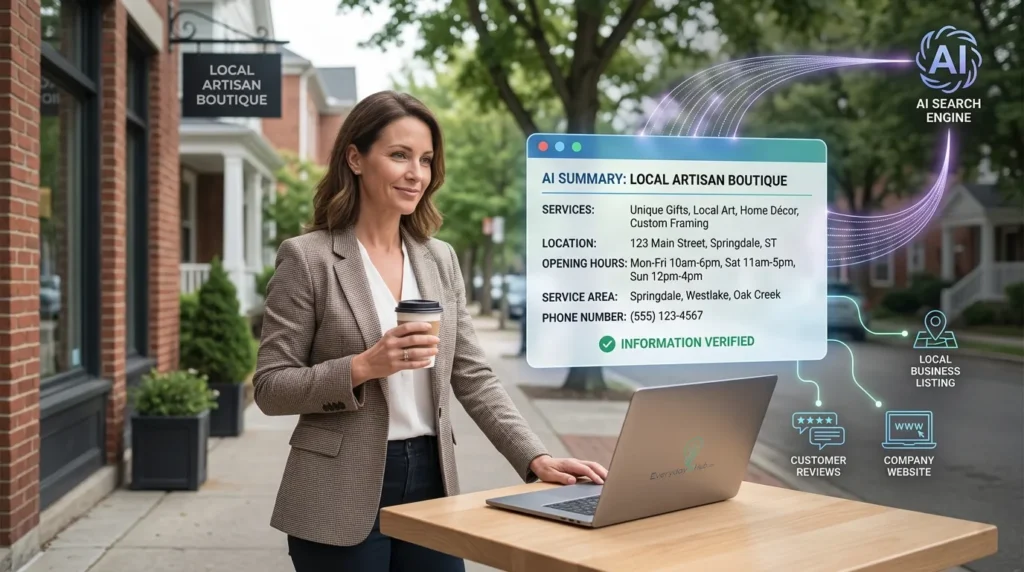
AI search is changing how customers find businesses. Instead of opening five tabs, comparing prices, and reading reviews one by one, people can now just ask an AI assistant:
What are the best HVAC companies near me that offer emergency weekend service?
Or: How much does this company charge?
Or: Is this business reliable?
The AI’s answer comes from all over the web. Your website might have the right information, but the AI could just as easily pull from an old directory listing, a stale review, a PDF nobody’s touched in three years, or a third-party profile someone else set up and forgot about.
You can’t log into ChatGPT, Gemini, or Perplexity and edit what they say about your company. But you can make your business information easier to find, easier to verify, and consistent everywhere it shows up. That’s what this guide walks through.
Why AI Accuracy Matters for Small Businesses
Think about what a potential customer needs to know before they pick up the phone: what you sell, where you’re located, what areas you cover, your hours, your pricing, whether you handle emergencies, whether you’re even taking new customers, and what other people think of you.
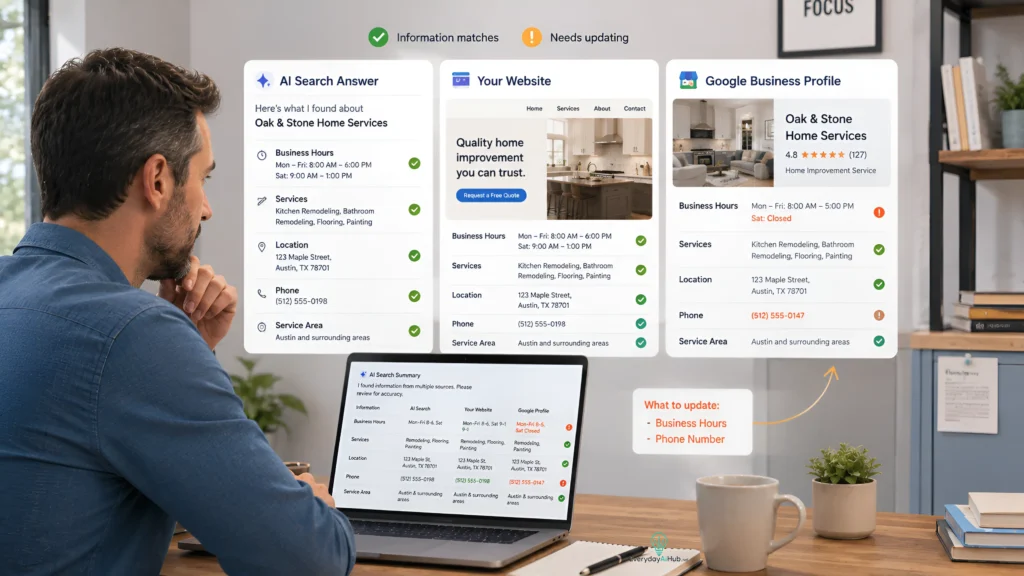
Normally, a customer would land on your website and find this out for themselves. AI search skips that step. It summarizes information from several sources and hands the customer an answer before they ever visit your site. That’s great when the information is right, and a real problem when it isn’t.
Say your website lists hours until 7 PM, but an old directory listing says 5 PM. A customer asking an AI assistant has no way of knowing which one is correct, and honestly, neither does the AI.
Same story with services, locations, pricing, and policies. If your information isn’t consistent, you’re leaving it up to chance which version gets repeated back to a customer.
Your online information needs to be consistent.
You Can’t Fully Control What AI Says About You
A lot of “AI SEO” advice glosses over this, so let’s be direct about it: there’s no reliable way to control every answer ChatGPT, Gemini, Claude, or Perplexity generates about your business.
These systems pull from different sources, rank and retrieve information differently, and update on their own schedules. Even a perfectly written website can still get misread or skipped over.
Treat this as cleaning up your digital footprint rather than controlling AI outright, so search engines and AI systems have better material to work with in the first place.
Google’s own guidance backs this up. In its “AI Features and Your Website” documentation, published in May 2025, Google states that there are no additional requirements or special optimizations needed to appear in AI Overviews or AI Mode, and that the same SEO fundamentals that have always mattered still apply because these features are built on Google’s core Search systems.
What Can Go Wrong?
Here’s what to watch for.
1. Outdated Business Information
Businesses change. Hours shift, services get dropped, locations move, phone numbers change, service areas expand or shrink.
Old information can sit online for years on sites you don’t control. And when different sources disagree, it gets a lot harder for any search system, human or AI, to know what’s current.
2. Missing Information
Sometimes the problem is incomplete information rather than wrong information. Your website might say “we provide commercial plumbing services,” which is true, but it leaves a lot unanswered.
- Do you handle emergency repairs?
- Which cities do you serve?
- Do you work with restaurants?
- Do you offer maintenance contracts, weekend appointments, free estimates?
The more specific you are, the less an AI system has to guess, and the less room there is for it to guess wrong.
3. Conflicting Information Across the Web
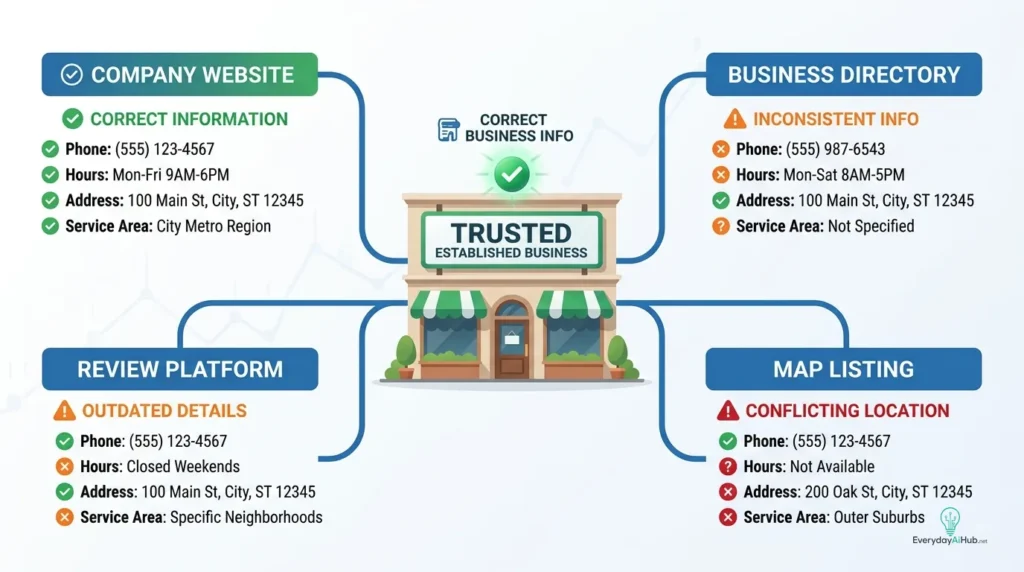
This is the one that hurts local businesses most. Picture your details laid out like this:
| Information | Your Website | Directory A | Directory B |
| Phone | 555-1234 | 555-1234 | 555-9876 |
| Hours | 8 AM–6 PM | 9 AM–5 PM | 8 AM–6 PM |
| Address | 100 Main St | 100 Main St | 120 Main St |
| Service Area | Austin | Austin + Dallas | Austin |
A human customer might eventually piece together which version is right. An automated system has a much harder time doing that, which is exactly why keeping your information consistent across the platforms that matter is worth the effort.
A Practical Six-Step AI Visibility Strategy
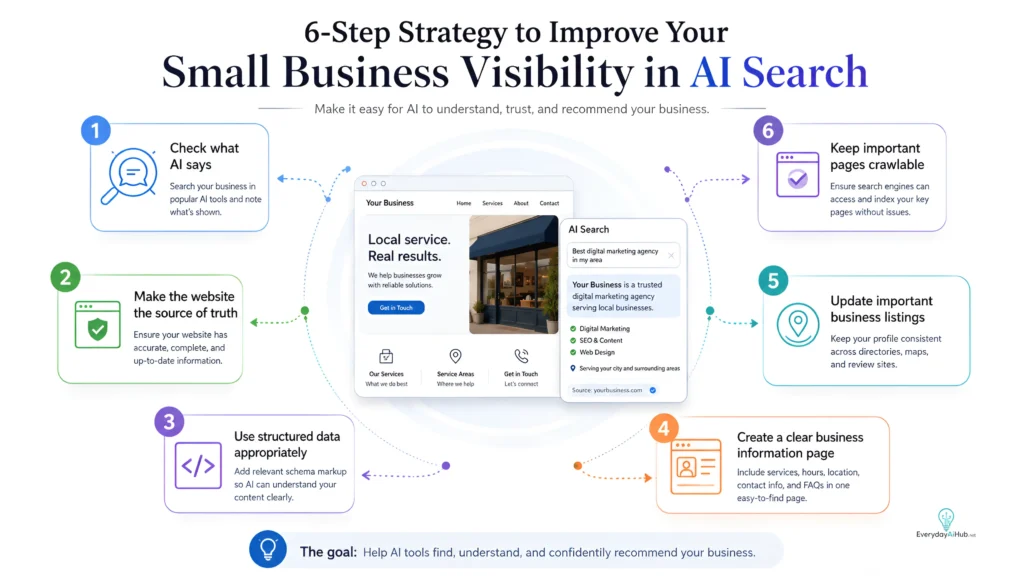
You don’t need an expensive “AI optimization” campaign. Start with the basics.
Step 1: Ask AI Systems What They Currently Say
Before you change anything, find out what’s already being said about you. Test your business across a few AI and search tools your customers might realistically use:
- What are customers saying about [Business Name]?
- What services does [Business Name] offer?
- Where is [Business Name] located?
- What are the opening hours for [Business Name]?
- Does [Business Name] offer emergency service?
- How does [Business Name] compare with [Competitor]?
Don’t take the answers at face value. Check them against your actual business information, and put the results in a spreadsheet so you can actually track what’s wrong:
| Question | AI Answer | Correct? | Problem | Source |
| Opening hours | 9 AM–5 PM | No | Actual hours are 8 AM–6 PM | Directory |
| Services | Plumbing + HVAC | No | HVAC discontinued | Old profile |
| Location | Main Street | Yes | Correct | Website |
That turns a vague “AI doesn’t know my business” complaint into a list of things you can fix.
Step 2: Make Your Website the Clear Source of Truth
Your website should make basic business information easy to find. Don’t bury it inside clever marketing copy. Give it clear sections.
Business Details
Name, address, phone number, email, hours, service area.
Products or Services
Explain exactly what you offer, and say what you don’t offer when it matters. “We provide residential electrical repairs. We do not provide commercial electrical installation” tells a customer, and a search system, far more than “we provide complete electrical solutions for every need.”
Pricing
If you publish pricing, keep it current and explain what makes it vary. “Residential diagnostic visits start at $89. Final repair costs depend on the work required” is a real, check-able claim. The goal is to make your pricing legible to a person reading it, not to feed AI some magic pricing input.
Step 3: Use Structured Data, But Don’t Treat It Like an AI Hack
Structured data helps search engines understand a page. Google says it can help systems interpret content and can make pages eligible for certain search features, as long as the markup matches what’s visible on the page.
For a local business, that usually means: name, address, phone number, hours, website, business type, and services.
Don’t assume piling on more schema will get ChatGPT to mention you first. There’s no evidence that works, and Google is explicit that there’s no special schema markup required for generative AI search.
If anything, Google warns against over-focusing on it. Treat structured data as part of solid technical SEO, not a secret AI-ranking shortcut, and make sure it matches what’s on the page.
Step 4: Create a Clear Business Information Page
If your business details are scattered across a dozen pages, a dedicated page can help pull it together. Call it /about/, /company-information/, whatever. The URL matters far less than the content. Keep it simple, something like:
About Precision Auto Tech
Business type: Independent automotive repair shop
Location: Austin, Texas
Founded: 2014
Services: Brake repair, engine diagnostics, routine maintenance
Service area: Austin and surrounding communities
Diagnostic fee: $89
Hours: Monday–Friday, 8 AM–5 PM
Not offered: Body painting and structural frame restoration
Pages like this are useful for people, not just machines. Build it for the human reading it, and it’ll work for the AI summarizing it too.
Step 5: Clean Up Your Important Business Listings
Now look past your own website, starting with the platforms your customers actually use: Google Business Profile, Apple Maps, Bing Places, Yelp, industry directories, Chamber of Commerce listings, major review platforms, and any local publications that cover you.
Check the same fields everywhere: name, address, phone number, website, hours, services, service area, description.
You don’t need to fix every obscure directory on day one. Prioritize the platforms that are authoritative, visible to customers, or frequently referenced, and don’t create fake listings just to rack up mentions.
Google’s current guidance emphasizes high-quality, useful information and specifically warns against manipulative tactics designed to influence generative AI responses.
Step 6: Keep Important Pages Crawlable
Search systems can only work with what they can access, so technical SEO still matters. Google’s documentation is clear that pages need to be crawlable and indexable to qualify for its AI search features at all.
robots.txt tells crawlers which URLs they’re allowed to request, but it isn’t the same tool as noindex. Google says robots.txt is meant to manage crawling, not to be the main way you keep a page out of search results. Use noindex, or another proper access restriction, for that.
So don’t just add a rule allowing GPTBot and assume that guarantees better AI visibility. Crawler policies are messier than that, and different AI companies run different systems with different rules.
Check what your site is allowing and blocking, and make sure you’re not accidentally hiding content that should be public.
Don’t Forget About Traditional SEO
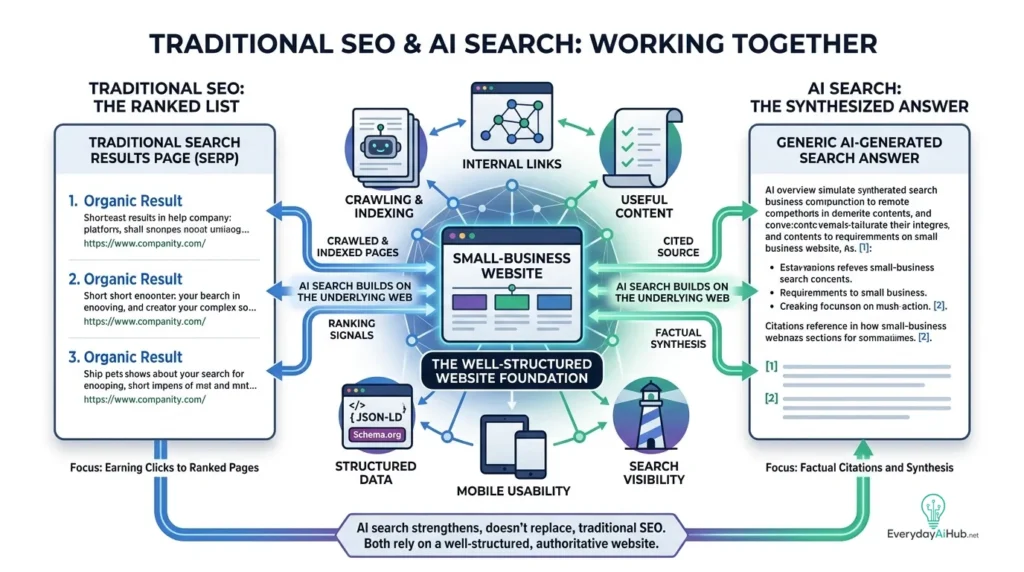
This is the part that gets skipped most often: you don’t need to throw out SEO because AI search exists. Google is direct about this too. Its generative AI features rely on the same core Search systems as everything else, so the fundamentals still count.
That means crawl-ability, indexing, internal links, page quality, useful content, clear titles, descriptive headings, a good page experience, relevant images, accurate business information, legitimate citations, and mobile usability all still matter.
AI search is another way people find information. It doesn’t replace the web underneath it.
Build Real Authority, Not Artificial Mentions
You’ll hear advice pushing businesses to get mentioned on as many sites as possible because AI systems supposedly “count mentions.” Be skeptical of that framing.
Legitimate coverage genuinely helps: an industry publication writes about your company, a local paper interviews the owner, your chamber of commerce publishes a profile, a respected site in your field references your work, a podcast quotes you. Those work because they add real context.
Manufacturing hundreds of low-quality mentions to grab an AI system’s attention doesn’t work the same way. Google’s guidance specifically warns against chasing inauthentic mentions as an AI-optimization strategy. Earn real mentions by doing things actually worth mentioning.
Monitor What Changes Over Time
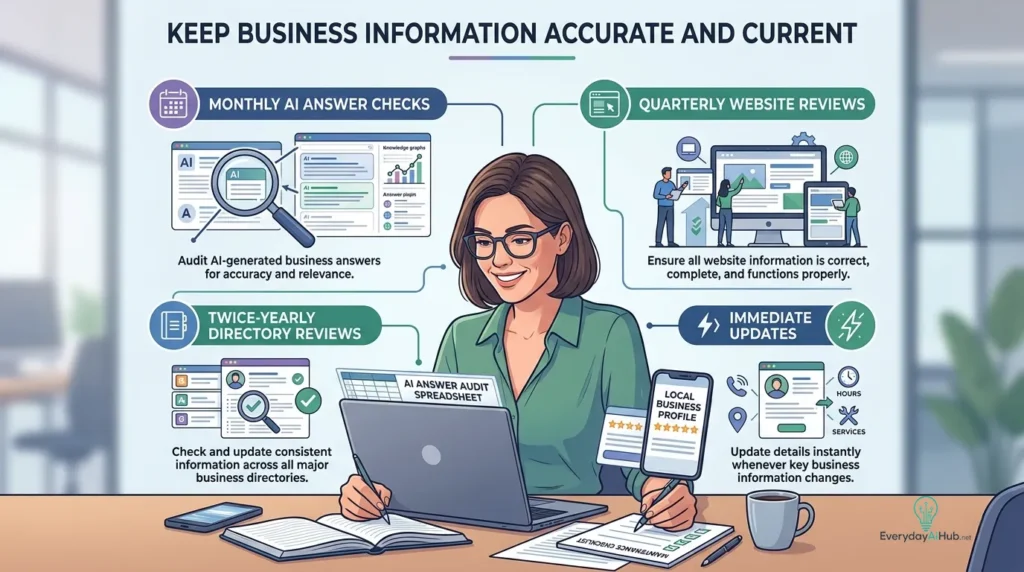
None of this is a one-time fix. Hours change, services change, employees change, prices change, locations move, reviews pile up, and new sites publish new things about you. AI systems change too. Treat this as ongoing maintenance, not a project with an end date.
Once a Month: Ask a few AI and search systems basic questions about your business (services, hours, location, pricing, service area, contact info) and check the answers.
Every Quarter: Review your website’s business information, structured data, key service pages, contact details, and business profile links.
Twice a Year: Check your important third-party listings for old phone numbers, old addresses, discontinued services, outdated descriptions, and wrong hours.
Whenever Something Important Changes: Don’t wait for the next scheduled check. Update your website and key business profiles right away.
Google Search Console Now Has AI Visibility Data
Here’s a real update worth knowing about. Google launched a dedicated Search Generative AI performance report inside Search Console on June 3, 2026.
It shows impressions across AI Overviews, AI Mode, and generative features in Discover, broken down by page, country, device, and date. Data starts from May 18, 2026, with no backfill before that.
A few things worth knowing before you go looking for it:
- It’s impressions only, for now. There’s no click data, click-through rate, or query-level data yet. You’ll see how often your pages showed up in an AI answer, not how many people actually clicked through.
- It launched to a limited set of sites first, initially concentrated among UK-based properties, with a wider rollout planned but no confirmed date.
- Google also added an opt-out toggle that lets you block your content from AI Overviews, AI Mode, and Discover’s AI features without affecting your regular search rankings. For most businesses, opting out isn’t the right call since AI search is becoming a real discovery channel, but it’s there if you have a specific reason to use it.
- It only covers Google’s own AI surfaces. It won’t tell you anything about how you’re showing up in ChatGPT, Perplexity, or Claude. Those still need to be checked manually, the way this guide describes in Step 1.
If the report shows up in your account, it’s worth checking. It gives you actual data instead of guessing whether your site is “optimized for AI,” which is a much better basis for making decisions than a hunch.
A Simple AI Brand Accuracy Checklist
Run through this once a month:
- [ ] Ask AI systems what they know about your business
- [ ] Check your business name
- [ ] Check your address
- [ ] Check your phone number
- [ ] Check opening hours
- [ ] Check your services
- [ ] Check your service area
- [ ] Check important pricing information
- [ ] Check how your business is described
- [ ] Look at the sources cited in AI answers
- [ ] Correct important information on those sources
- [ ] Review your Google Business Profile
- [ ] Review other important business directories
- [ ] Check important website pages
- [ ] Check your structured data
- [ ] Check that important public pages can be crawled
- [ ] Monitor Search Console for changes in search visibility
The Bigger Picture
The real goal is making sure the information available about your business is accurate, useful, current, and consistent, not getting an AI assistant to say something flattering. Those are two different objectives, and the second one is the only one you have any control over.
You can’t guarantee an AI assistant will recommend you, interpret your information correctly, or treat your website as its only source.
What you can control is the information underneath all of it: your own website, your business profiles, the inconsistencies between them, your structured data, whether your public pages can be crawled, and the quality of what you publish. Do that well, earn real mentions along the way, and see what happens.
That’s a more realistic approach than chasing some secret “GEO hack.” It comes down to being the clearest, most trustworthy source of information about your own business, rather than trying to control what a machine says about you.

Michael L. has spent the last one year writing about AI for people who never planned to care about it. He tests tools, cuts through the hype, and explains what actually works for everyday life and small business. No tech background required.